
Symphony No. 3 by Brahms the Bachelor
 As we approach the end of the 2007-08 season, we return to our Spotlight Composers. While next week holds Golijov’s monumental Ainadamar in store, this week we hear Brahms’ Symphony No. 3. Each Brahms symphony is a gem, and each for a different reason. What makes the Third so revered is its matchless combination of soaring (even catchy) melodies and raw power.
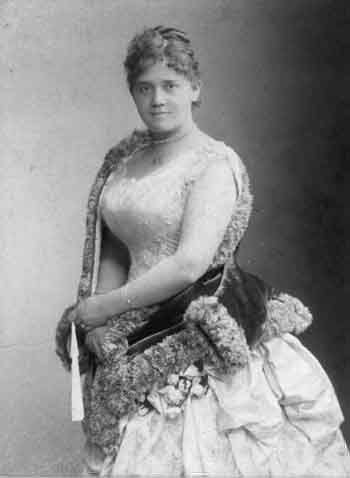
Like so much of Brahms’ work, the Third Symphony was written on a summer holiday (this time in Wiesbaden) and several musicologists speculate that Brahms – a lifelong bachelor – may have been feeling pangs of regret or unrest at his bachelor status. He chose Wiesbaden primarily to be near a singer, Hermine Spies (pictured at right), who he had grown very fond of, and because she was far too young for the 50 year-old composer, Brahms must have felt at least like he was getting old, and quite possibly that his chance for marriage had passed forever.
Coupled with the three-note, F-A-F, Frei Aber Froh! (Free but happy!) theme that – in typical complex puzzle-like Brahms fashion – so completely saturates the symphony, it’s easy for one to believe that love was on the composer’s mind as he sat to pen this symphony.
Maybe this can explain the unlikely bedfellows of tender melodies and Brahmsian grandeur that make this masterpiece an audience favorite again and again. Just how these complex emotions interact in and shape the music is for you to decide.
11 Comments:
A programming question, if I may. Why is the Shostakovich Hamlet suite the 2nd half of a Brahms and Khachaturian concert? I would expect a fair percentage of the audience to quickly depart at intermission, which makes things worse for those of us who will stay for the Shostakovich since the Hall sounds much better when it has more people in it. What was the thought process here?
It is my understanding that Brahms 3rd has always posed a programming dilemma for conductors. That is because it doesn't end with climactic fanfares and bombast. Just a nice resolving chord. That's why playing it as THE first half of a concert makes sense. I heard Ashkenazy and the Cleveland Orchestra do it that way.
Maestro Christie's method of programming classical giants in the first half and lighter chestnuts at the end have been a hit or miss. I actually fell asleep when he played Copland's Billy the Kid Suite as the finale.
This time we get the rarely heard Shostakovich suite from the movie soundtrack "Hamlet." Totally different piece than his Incidental Music to "Hamlet," the play. I expect to be marching out of Symphony Hall at the end humming the tunes from "The Ghost" movement starring the tuba and "The Death of Hamlet-Hamlet's Funeral."
Yeah, if you end a concert with a quiet ending the audience gets confused and doesn't know when to clap. We did Tchaikovsky 6 with my local orchestra where the audience prides itself in being "cultured" and there was one person in the audience, while the basses were still playing at the end, who just wouldn't give up trying to applaud. It was almost like they were trying to let everyone else know that despite the very soft ending they knew the piece was over. It was so sad it was comical and totally ruined the moment.
Sonny,
The Symphony will not be performing the Ghost movement from the soundtrack, but I think you will enjoy the other selections from the suite.
Kevin Kramer
Head Librarian
Like Beethoven's Symphony 6, Brahms' 3rd Symphony is not a closer as Sonny describes about the Cleveland Orchestra. I will tell you that if you miss the Khachaturian you will be very sad, this is Karen's piece and she plays the hell out of it. Great solos for the orchestra as well, particularly for french horn, clarinet, cellos and the viola section. There is a long interlude just for the viola section! You'll love it!
Karen and I have done this piece together with the St. Louis and Utah Symphonies and EVERYTIME she has knocked the ball out of the park. Could be one of the best soloist performances of the season in my opinion.
About this upside down programming.... it's about the pieces themselves rather than the format that is important to me. What puts each work in the best light AND hopefully intensifies the experience for the listener as well. I really think you'll love the order chosen for this program.
I didn't like the order of this program at all. Ending with the Shostakovich didn't do it for me, nor my neighbors in the hall this evening. I would have much preferred the program had it been played in the reverse order, or if some other piece had been played first (perhaps something from Bartok?), then the Khachaturian, an intermission, and then the Brahms, and save the Shostakovich for a different program.
You might also consider playing the symphonic portion of the Khachaturian with a bit less volume, as there were times when the orchestra drowned out the lovely sound of Ms. Gomyo's Stradivarius.
One of the things I enjoyed the most about the way Gunther Herbig conducted is that he didn't blast the music out at us. Instead, he had the orchestra play a bit softer which really brought out the texture and dynamics of the pieces, particularly the Schubert. This same approach would have greatly enhanced my experience on Thursday evening.
Kudos to the orchestra for playing their arms and lungs off in a difficult program near the end of the season. You folks always give us everything you have to give, and it is very much appreciated.
Very poor programming.
The concert should have ended (and it did for a lot of people who left) after the Khachaturian.
Karen Gomyo brought the house down with the most intense and loud playing of a very long concerto.
It was already 10:15 p.m.
We had already experienced a slow and beautiful chamber-music-like
Brahms Symphony No. 3 in the first half. (Somebody should have announced the printing error in the program that said the intermission would follow the violin concerto.) Maestro Christie's critics should have been overjoyed with the Mahleresque broad Andante 2nd movement, followed by yet another slow 3rd movement. I was touched by the wind solos just floating out from behind the strings.
The Shostakovich was absolutely worthless! You failed to list the movements being played. Moreover, you omitted movements from the standard Op. 116a suite. This was nothing but a "cut and paste" job. I am a diehard Shostakovich fan, but this type of inconsequential offering ruined an otherwise perfect evening.
Another brilliant performance by another young artist! Thank you, Maestro Christie, for programming the Khachaturian concerto by Karen Gomyo! More of the same, please. Such performances by young artists are inspirational on several levels.
We enjoyed last night's concert very much. The soloist was superb. She "attacked" the violin the way Rostropovich "attacked" the cello and we loved her performance. Please bring her back.
I want to thank Maestro Christie for discovering her. (Did you find out about her during one of your stays in New York?) I was also pleased that the orchestra did not drown out the soloist as it had on some previous occasions.
Thanks also for curtailing the Shostakovich. It was a good move given the late hour and how long the post-intermission part of the concert would have lasted. Good judgment call.
1) The concert was too long - way, way, too long. Just the Brahms & Khachaturian would have been sufficient.
2) Brahms didn't like first movement repeats, and he didn't play them when he conducted. He only wrote them to be "classically correct". They are very weak and I don't think he cared. In general, at a time when we all know the music so well, there's no point of first movement repeats. Not even in the Mahler 6th!
3) The program notes once again missed something significant: why do so few people recognize the first theme of this symphony (and the one that closes it) is a tribute to Schumann. Brahms' quote of the theme from the Rhenish is hardly impossible to miss. Mahler in turn quotes the Brahms 3rd in his 4th symphony. I'll leave it to the curious to figure out where. Mahler didn't do it deliberately, but he sure knew he did it. Read La Grange.
4) I loved the concert. One of the most satisfying and electrifying concerts I've been too in a long time. MORE KHACHATURIAN! Maestro Chrisie seems to have a knack for it.
Karen has played over here on the east coast with our orchestra a few times over the years and it is always a treat to have her visit. Glad to hear that Phoenix enjoyed this "discovery". I guess now our secret is out and we'll have to share Karen's talent with you guys over there on the other side of the country.
Post a Comment
<< Home